
A look at what may sit behind a short fuse, including feelings that can be hard to name, and questions to bring to therapy.
Anger gets a bad reputation, but it is rarely the real problem. For a lot of men it is the one emotion that has a clear exit. Sadness, fear, shame, feeling overwhelmed: those got shut down a long time ago. Anger did not. So everything underneath comes out wearing the same face.
If your reactions keep landing harder than you mean them to, it is worth looking at what is actually driving them.
Anger is the tip, not the iceberg
Picture an iceberg. The part above the water (the snapping, the cold shoulder, the slammed door) is small and visible. The much larger part sits underneath, out of sight. That is where the real material is.
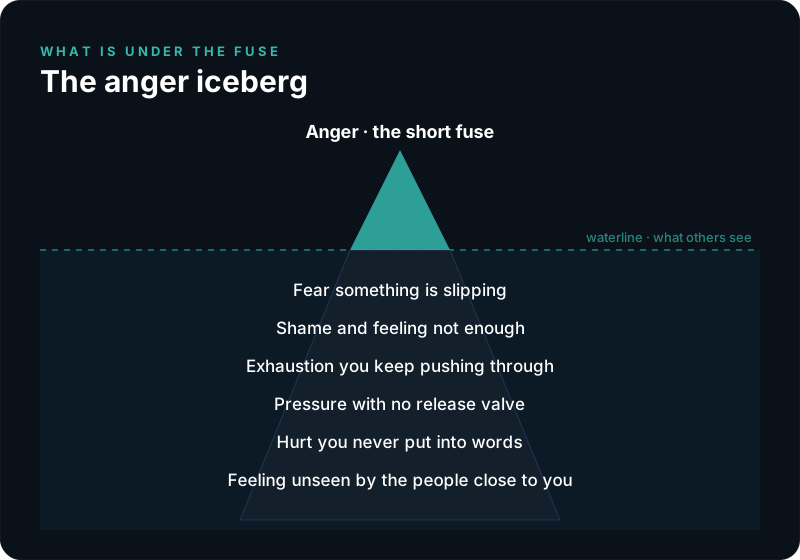
When a small thing sets you off way past what it deserves, that is the tell. The reaction is not really about the dishes or the traffic or the tone of one comment. It is carrying everything below the line, and the trigger just cracked the surface.
What usually sits underneath
For the men I work with, the stuff below the waterline is some mix of:
- Fear that something is slipping: at work, at home, in your own body
- Shame and the quiet sense of not being enough, no matter the output
- Exhaustion you have been overriding for months
- Pressure with no release valve and no one to hand it to
- Hurt you never put into words
- Feeling unseen by the people closest to you
None of that is soft or weak. It is just human, and it has been stored with nowhere to go. Anger is what it sounds like when it finally leaks.
Why "just control your temper" misses the point
Telling a man to control his anger treats the tip of the iceberg as the whole thing. You can white-knuckle your reactions for a while, but if the stuff underneath never gets dealt with, the pressure just builds until the next blow-up. Control alone is a lid on a pot, not a lower flame.
The actual work is two-part: turn the heat down underneath, and build a cleaner way for what is real to come out.
Working with it instead of against it
- Read the early signals. Anger has a runway: jaw tightening, heat in the chest, clipped replies. Catching it there gives you room to choose. Catching it after the snap does not.
- Find the layer under it. In the moment, or right after, ask what the anger is actually protecting. Tired? Scared? Embarrassed? Unseen? Naming it changes what you do next.
- Give it a real exit. The charge is physical, so part of the release has to be too: movement, breath, a genuine reset before you respond.
- Say the real thing. "I am at capacity and I am scared I am dropping the ball" lands completely differently than going off about something small. It is also far harder to do, which is part of the work.
- Repair well. Everyone slips. A clean repair, owning your part without grovelling, protects the relationship and lowers the shame that feeds the next round.
This is not about becoming passive
Plenty of men worry that working on anger means becoming a doormat. It is the opposite. Handling your anger well is a stronger position than exploding or going cold. You stay in the conversation, you say what is true, and you stop doing damage you have to clean up later. That is control, not weakness.
If the short fuse is costing you at home or at work, anger management for men is built around exactly this. Because anger and anxiety so often run on the same overloaded system, we usually look at both. You can book a free consultation to talk it through, no pressure.
This article is general information, not a substitute for individual care. If you are in crisis, call 911 or the 9-8-8 Suicide Crisis Helpline.