
A look at anxiety, irritability and a short fuse, with questions to help you reflect on what is happening and discuss support.
A lot of men never describe themselves as anxious. They describe themselves as stressed, wired, or quick to snap. The picture in their head of anxiety is someone who looks visibly nervous, and that is not them. So the anxiety hides in plain sight, and it often comes out as anger.
If you are short with the people you care about and you cannot quite explain why, this might be the missing piece.
Why anxiety turns into irritability
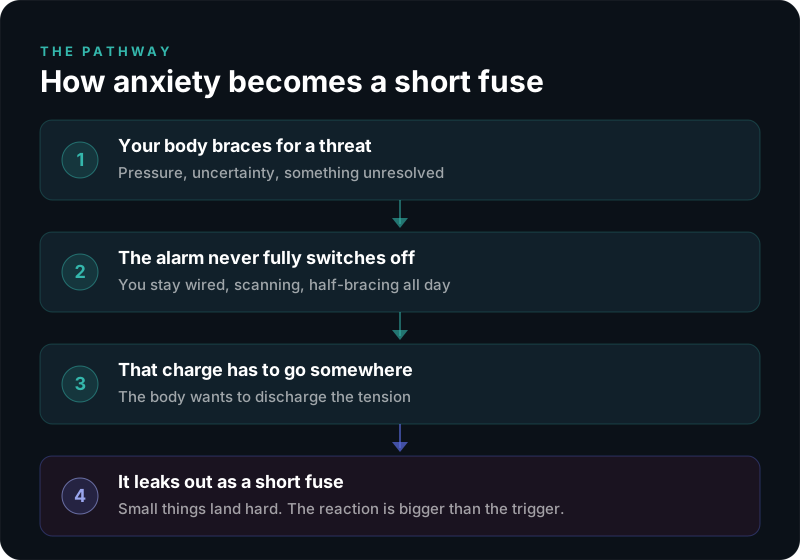
Anxiety is your nervous system staying on guard. When the body is braced for a threat that never quite arrives, that energy has to go somewhere. For many men it leaks out as a short fuse. Small things land hard: traffic, a slow reply, a question at the wrong moment. The reaction feels bigger than the trigger because it is carrying everything underneath it.
This is not a character flaw. It is a regulation problem. The goal is not to become someone who feels nothing. The goal is to notice the build-up earlier and have somewhere to put it.
What it can look like day to day
- Snapping at the people closest to you, then feeling guilty
- Tension in your jaw, chest, or shoulders for no clear reason
- Going quiet and shutting down instead of saying what is wrong
- Needing control over small things to feel okay
- Replaying conversations and bracing for the next problem
- A low hum of "something is about to go wrong" that never fully lifts
If several of those are familiar, the issue may not be anger at all. It may be an anxious nervous system that has only one exit.
Why "just calm down" never works
Telling yourself to calm down does not work, because the nervous system does not take orders. The thinking part of your brain is not the part that is activated. What helps is building skills that lower the baseline charge and give the energy a different exit before it reaches the snap.
A more useful approach
- Catch it earlier. Learn your own early warning signs (the jaw, the shoulders, the clipped replies) so you are working with the build-up, not the explosion.
- Discharge the energy. Movement, breath, and a short reset break the spike before it drives the reaction. The charge is physical, so the release has to be too.
- Name the real thing. Anger is usually the visible layer over pressure, fear, or feeling unseen. Saying the real thing, even just to yourself, changes the loop.
- Repair fast. When you do snap, a clean repair protects the relationship and lowers the shame that fuels the next round. How you come back matters more than never slipping.
The point is not to white-knuckle your reactions forever. It is to turn the baseline down so there is less to react from in the first place.
Where to start
If you recognise yourself here, both anxiety support and anger management work directly on this. They are two angles on the same underlying system: calm the anxiety and the fuse gets longer; learn to handle the anger and the anxiety has less power. We figure out which angle fits where you actually are.
If you want practical tools for this, you can book a free consultation. It is a 30 minute conversation, no pressure, to see if the approach fits.
This article is general information, not a substitute for individual care. If you are in crisis, call 911 or the 9-8-8 Suicide Crisis Helpline.